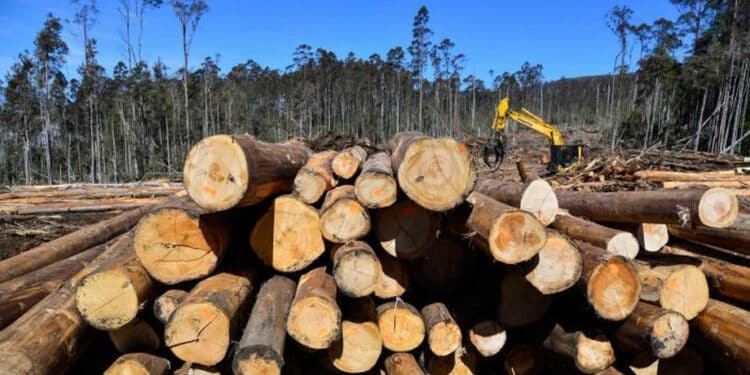
The Green Belt Movement (GBM) and Greenpeace Africa have jointly condemned the Kenyan government’s decision to lift the logging ban in the Mau Forest Complex, calling it a dangerous setback for environmental conservation, water security, and climate resilience.
The two leading environmental organizations are urging the government to immediately halt all logging activities until it ensures transparency, legal compliance, and meaningful public participation in forest management.
In a joint statement issued on Wednesday, October 29, 2025, GBM and Greenpeace Africa said the move violates court orders, exposes governance failures, and threatens the livelihoods of millions of Kenyans who depend on the Mau for water, agriculture, and stable weather patterns.
“The decision undermines years of progress in forest protection and exposes Kenya's fragile ecosystems to renewed destruction,” the statement read. “It also stands in clear contradiction to the government’s own pledges on environmental conservation and climate action.”
The Mau Forest Complex is one of Kenya’s five major water towers, feeding critical rivers and sustaining ecosystems across the Rift Valley, Western, and Nyanza regions.
According to the groups, allowing logging in such a sensitive area would endanger the country’s food and water security, worsening droughts and floods, and undermining climate adaptation efforts.
Citing the Forest Status Report 2024, the statement warned that Kenya already loses an average of 84,716 hectares of forest annually to deforestation, costing the economy an estimated Sh534 billion each year in lost ecosystem services, reduced rainfall, and soil erosion.
“It is deeply ironic to call on citizens to plant trees while sanctioning activities that destroy those that have taken decades to grow,” the groups said. “Such policy inconsistency erodes public trust and makes a mockery of Kenya’s climate commitments.”
The two organizations further noted that the lifting of the ban disregards a 2023 Environment and Land Court ruling, which required the government to establish a framework for proactive information sharing, public participation, and independent oversight before resuming any harvesting.
“There has been no public disclosure of any such framework and no evidence of compliance with these legal requirements,” the statement said, adding that governance weaknesses identified in the 2018 Taskforce Report on Forest Resources Management remain unaddressed.
The groups made seven key recommendations, including full supervision of any harvesting by a Multi-Agency Oversight Team, increased forest protection capacity for the Kenya Forest Service, and investment in private commercial plantations to reduce pressure on public forests.
“Kenya cannot claim to be planting 15 billion trees with one hand while destroying its public forests with the other,” they warned. “The Mau Forest Complex is too important to be treated as a political bargaining chip.”
The two groups urged the government to align its development agenda with genuine environmental stewardship, saying Kenya’s future resilience depends on protecting its forests.
“Sustainable growth depends on healthy ecosystems,” the statement emphasized. “Forests are not barriers to progress,they are the foundation of water security, agriculture, and economic resilience.”
President William Ruto on Monday, October 27, 2025, announced the lifting of the national logging ban to permit the harvesting of mature trees in designated forests across the country.
He said the decision is intended to revive local industries and reduce Kenya’s reliance on imported timber products.
Speaking during a public engagement at Molo Technical and Vocational College in Elburgon, Nakuru County, President Ruto explained that the move will ensure mature trees are put to good use rather than being left to waste in forests.
“We shall reopen the timber factories here in Elburgon. I have told my Minister of Trade, Mr Lee Kinyanjui, that importing furniture from China must end. We will use our wood to make furniture,” President Ruto said.































Comments
Sign in with Google to comment, reply, and like comments.
Continue with Google